The Galaxy Zoo
An interactive infographic exploring the de Vaucouleurs extension of the Hubble Sequence.
Comparison Mode
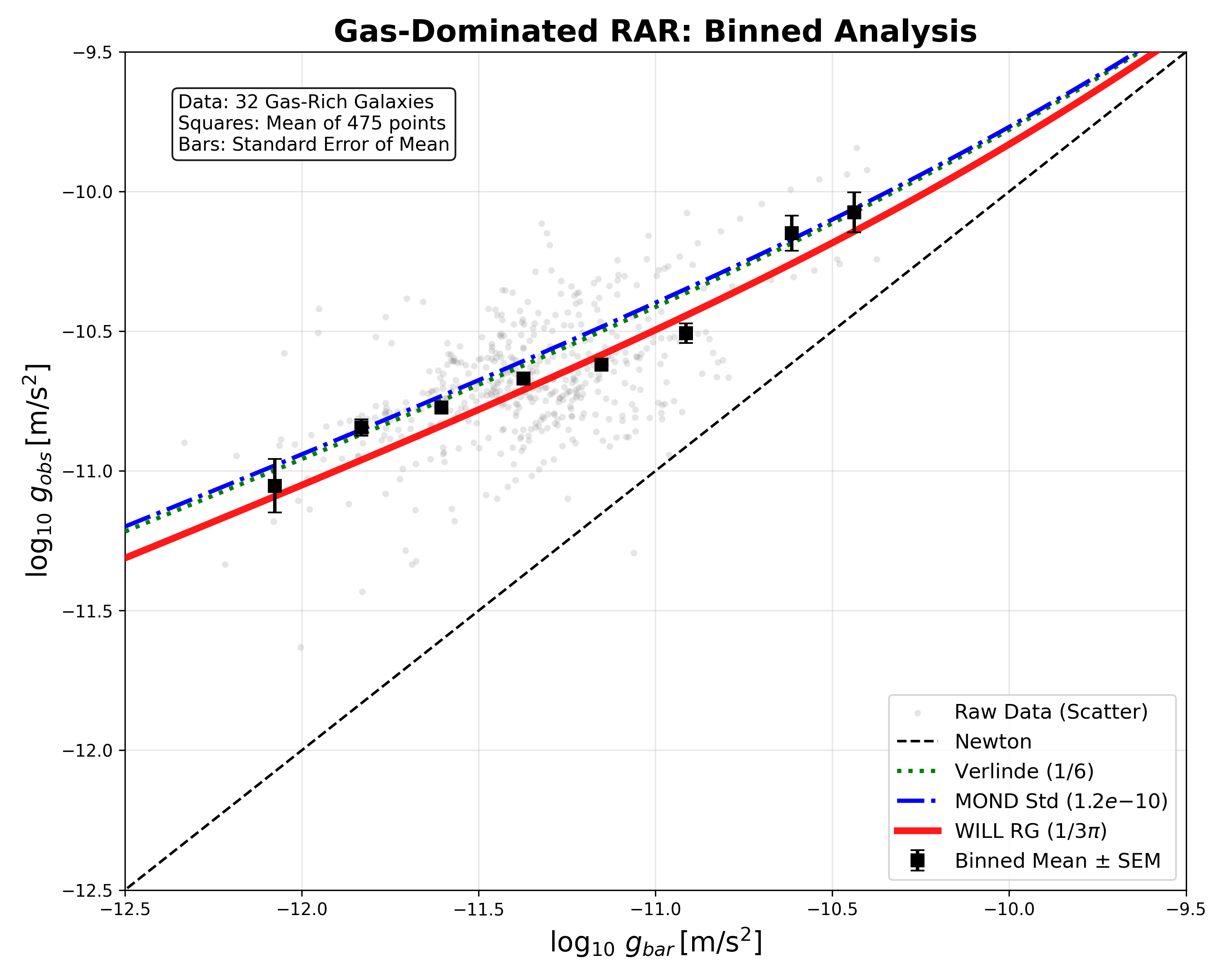
Galactic Rotation Curves without Dark Matter and without Free Parameters
Stars at the edge of a galaxy orbit faster than the visible matter can account for. Nothing invisible is added, and nothing is fitted.
Why the stars move too fast
The universe is relationally closed, so anything travelling through it eventually meets itself again. Only patterns that return in the same phase survive, which leaves the universe with a single lowest note. That note puts a minimum energy floor under every interaction inside it.
Out at the thin edge of a galaxy, the visible matter on its own would leave a star below that floor. It cannot sit below the floor, so it moves faster. The extra speed is not extra mass. It is the star keeping step with the universe, the same way an electron has to fit a standing wave to stay bound inside an atom.
The equation
\[V_{\rm obs}^2 = V_{\rm bar}^2 + \sqrt{V_{\rm bar}^2 \cdot a_{\kappa} \cdot r} \qquad a_{\kappa} = \frac{c H_0}{3\pi} \approx 0.70 \times 10^{-10}\ \mathrm{m/s^2}\]$V_{\rm bar}$ is what the visible matter alone would produce. The second term is the coupling to the horizon. Away from the visible mass it stops depending on radius, which is why the curve levels off instead of falling.
$a_{\kappa}$ is not a free parameter. $H_0 = 68.15$ km/s/Mpc is derived from the CMB temperature and the fine-structure constant. The $3\pi$ is the 2:1 split between the two relational carriers applied to that lowest note, worked out here.
SPARC: 175 galaxies, nothing tuned
Mass-to-light ratios held at the population-synthesis values for every galaxy, no per-galaxy parameters, raw residuals.
| Model | MedAE | Bias | $F_{10}$ |
|---|---|---|---|
| Newton, baryons only | 38.46 | $+36.91$ | 0.08 |
| $\Lambda$CDM, abundance matching | 13.32 | $-6.83$ | 0.36 |
| MOND, $a_0$ fitted to this dataset | 10.43 | $-4.37$ | 0.48 |
| Verlinde, $cH_0/6$ | 12.27 | $-8.52$ | 0.33 |
| WILL RG, $cH_0/3\pi$ derived | 11.18 | $\mathbf{-2.26}$ | 0.47 |
How to read it. MedAE is the typical velocity error in km/s, lower is better. Bias is observed minus predicted in km/s, so positive means the model runs too slow and negative too fast, and zero is the target. $F_{10}$ is the fraction of points landing within 10 km/s, higher is better.
MOND’s $a_0$ was fitted to these galaxies. $a_{\kappa}$ was derived from the microwave background and never saw a rotation curve. A number arriving from cosmology with nothing left to adjust reaches the accuracy of a formula built on the answer, and carries half its systematic bias.
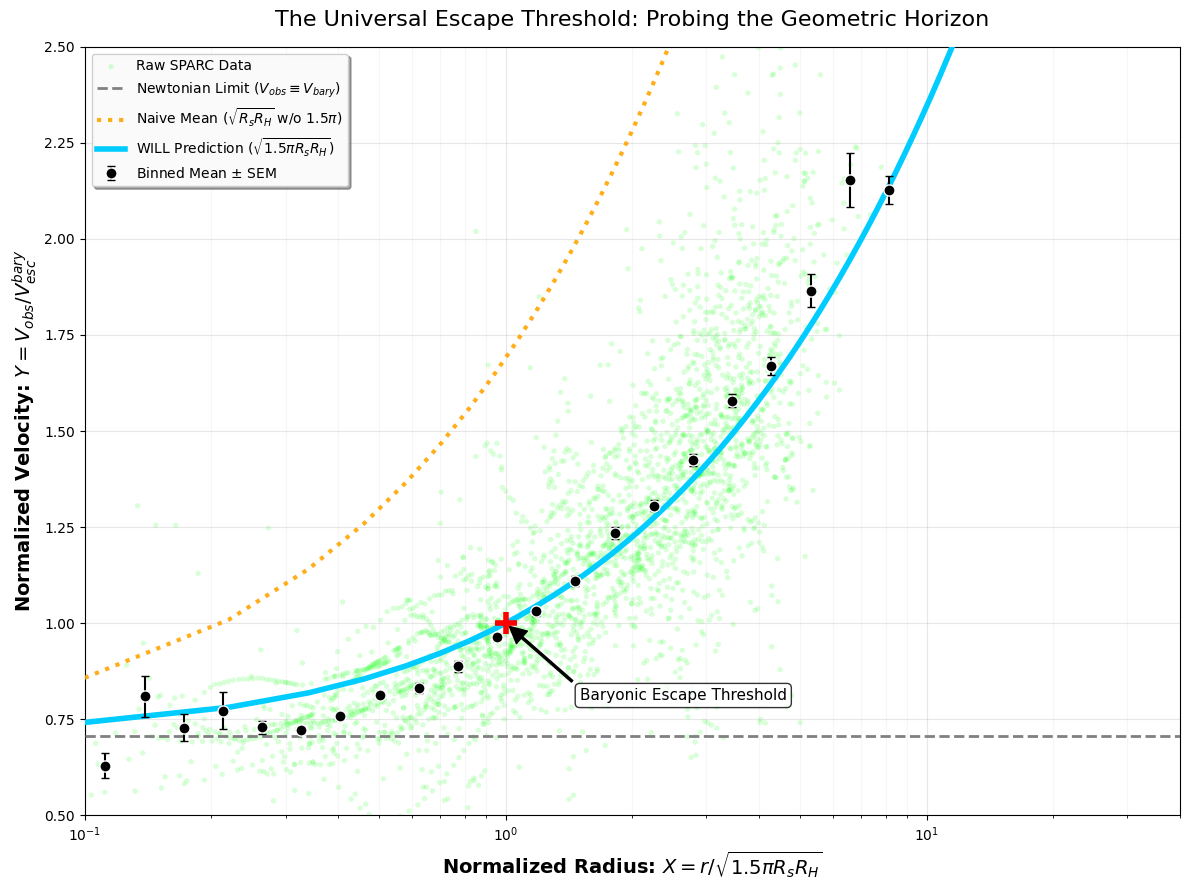
The escape threshold
At one radius the horizon term equals the baryonic term. There, and only there, orbital speed equals baryonic escape speed:
\[V_{\rm obs}(R_{\rm trans}) \equiv V_{\rm esc}^{\rm bary}, \qquad R_{\rm trans} = \sqrt{\tfrac{3\pi}{2}\, R_s R_H}\]That radius is the geometric mean of the galaxy’s own horizon and the cosmic horizon. Beyond it a star is moving faster than the visible matter could hold, and what keeps the orbit bound is the horizon, not hidden mass. Where the crossing falls is set entirely by $a_{\kappa}$, so the plot is a direct test of that number.
Wide binaries: where a fitted curve and a derivation part company
Wide binary stars are about a million times smaller than a galaxy. A galaxy couples to the horizon through the potential carrier at weight $2/3$. A binary is a two-body relation and couples through the kinetic carrier at $1/3$, giving exactly half the scale, $a_\beta = cH_0/6\pi$. Same derivation, different kind of link.
| Gravity boost at $g_N = 10^{-9.8}$ | $\gamma$ |
|---|---|
| Observed, Gaia DR3 | 1.45 to 1.55 |
| MOND, carrying its galaxy-fitted $a_0$ | 1.87 |
| WILL RG, kinetic channel | 1.47 |
MOND overshoots by more than 20% and needs an external field effect added by hand. Here the weaker anomaly is what the same closure condition already predicted.
From the same equation
| Result | Prediction | Observed |
|---|---|---|
| Milky Way at the solar radius | 226 km/s | $229 \pm 6$, Gaia |
| Baryonic Tully-Fisher slope | exactly 4 | $4.0 \pm 0.1$ |
| Strong lensing | isothermal profile, no halo | SLACS, $1.00 \pm 0.02$ |
Two limits the papers state directly: a weak-lensing forward model is named as future work, and systems that have not reached equilibrium, such as dwarf irregulars dominated by gas pressure, violate the closure condition the equation assumes.
Run it yourself
Every galaxy, the raw catalogue, the same zero-parameter equation, in your browser.
WILL Relational Geometry | Galactic Dynamics
Validating Vacuum Relational Acceleration against SPARC Database
Filter by Morphology (Hubble Type)
Stellar Mass-to-Light Ratios ($\Upsilon_*$)
Control the baryonic mass contribution
Full paper → WILL Relational Geometry Part II
Foundations → WILL Relational Geometry Part I
Code and data → GitHub/AntonRize/WILL